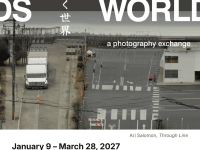
Looking out the window of a moving train, you take in far more than you can hold onto. Fences, backyards, stations, and hillsides arrive faster than the brain can sort them, so it keeps a few fragments and quietly fills in the rest. What we remember of a trip is never the whole route. It’s a stitched-together version, with some parts repeated, some skipped, and some blurred into a general impression of “landscape.”
These images are “linear panoramas,” and they make that editing process visible. The iPhone’s panorama mode is designed for someone standing still and slowly turning the camera across a scene. I do the opposite: I hold the phone steady at the train window and let the world move past it. The software, which builds the panorama from a narrow slice of video and the phone’s motion sensors, has to guess how fast the scene is going by. Out a train window, though, the foreground and background move at very different speeds, so it can only match one of them, usually the middle distance. The background repeats itself, the foreground smears and stretches, horizontal lines come through intact, verticals keep their shape but lose their spacing, and diagonals get chopped into pieces. By experimenting with the way the iPhone panorama stitching algorithm processes unexpected inputs, I guided it into showing its biases, much as we all see the world through our deeply programmed biases.
I started making these photographs in 2016 and showed them as framed prints under the title Rapid Express, at the Berkeley Art Center and at KG+ during Kyotographie. They grew out of two older series: Motion Studies, begun in college, about how a camera, an eye, and a brain each register movement differently, and Panoramas, about how memory compresses and edits space.
In Through Line, the photographs are no longer framed prints hung on the wall. They’re printed directly onto the gallery wall itself. A wall printer adds new images over the course of an exhibition, sometimes a whole new section and sometimes small fragments woven through what’s already there. The mural accumulates, overlaps, and changes, so the work is never quite finished, and a return visit shows something different. It debuts at Bedford Gallery in Walnut Creek, January 9 – March 28, 2027.


Installation Images